Rated 4.7 out of 5 stars
4.7 / 5


726,000+ customers
Free 60-Day Returns
1-Year Warranty
726,000+ customers
Free 60-Day Returns
1-Year Warranty
Handheld red light therapy devices have gone from niche wellness tools to everyday skincare essentials. And for good reason. They bring the same science used in professional dermatology offices into your bathroom, minus the appointment, the commute, and the price tag. But with so many options out there, how do you actually choose the right one?
Not all handheld devices are created equal. The difference between a device that delivers real results and one that collects dust in your drawer comes down to a few key factors.
The therapeutic benefits of red light therapy depend on the specific wavelengths the device emits. Red light at 630 nm is one of the most clinically studied wavelengths for skin, shown to support collagen production and visibly reduce the appearance of fine lines. Near-infrared light at 830nm penetrates deeper, reaching beyond the visible dermis to support circulation and cellular renewal. A device that combines multiple wavelengths can target different layers of skin simultaneously, delivering more comprehensive results.
A device can have the right wavelengths but still underperform if the irradiance (the amount of light energy reaching the skin) is too low. Higher irradiance means more efficient energy delivery per session, which is why professional-grade devices tend to outperform cheaper alternatives.
This isn't just a marketing badge. FDA clearance confirms that a device has been reviewed for safety and efficacy for consumer use. It's one of the clearest signals that you're investing in something legitimate.
Some of the best red light wands go beyond light therapy alone. Devices that combine red light with complementary technologies like therapeutic warmth, galvanic current, or facial massage can address multiple skin concerns in a single session.
The science behind red light therapy is called photobiomodulation, and it's been studied for over a century. Here's the simple version.
Your skin cells contain mitochondria, the tiny powerhouses that generate energy for cellular functions. When red and near-infrared light at specific wavelengths reach these mitochondria, they're absorbed by an enzyme called cytochrome c oxidase. This absorption triggers increased production of ATP (adenosine triphosphate), which is essentially the fuel your cells run on.
With more energy available, your skin's natural processes kick into higher gear. Fibroblast cells ramp up collagen and elastin production. Cell turnover accelerates. Inflammatory pathways calm down. Circulation improves, delivering more nutrients to the skin's surface.
The result over time is visibly smoother, firmer, more radiant skin. And because red light targets mitochondria rather than melanin, it's safe and effective across all Fitzpatrick skin types (I through VI), with no UV exposure, no irritation, and no downtime.
For a deeper look at the different form factors available, check out this guide to types of red light therapy devices.
The best device for you depends entirely on what you're trying to achieve. Here's how to think about it.
If your primary concerns are specific areas like smile lines, crow's feet, under-eye puffiness, or jawline definition, a handheld wand gives you the control to focus exactly where you need it.
The Solawave 4-in-1 Skincare Wand combines four synchronized technologies in one device. Red light therapy at 630nm visibly smooths fine lines and supports collagen over time. Galvanic current (not microcurrent, an important distinction) uses electrical polarity to drive hydrating serum actives like hyaluronic acid and peptides deeper into the skin than topical application alone. Therapeutic warmth supports circulation and reduces the visible appearance of puffiness. And facial massage vibration stimulates lymphatic drainage for a more lifted, sculpted look.
It's clinically tested, FDA-cleared, and takes just 12 minutes for a full-face treatment. The wand must be used with a water-based conductive serum for the galvanic current to function. The LightBoost Wand Activating Serum is formulated specifically for this, packed with hyaluronic acid, peptides, and the proprietary LightBoost Complex.
For help deciding if a wand is the right format, this guide to choosing the best red light wand for your face walks through the details.
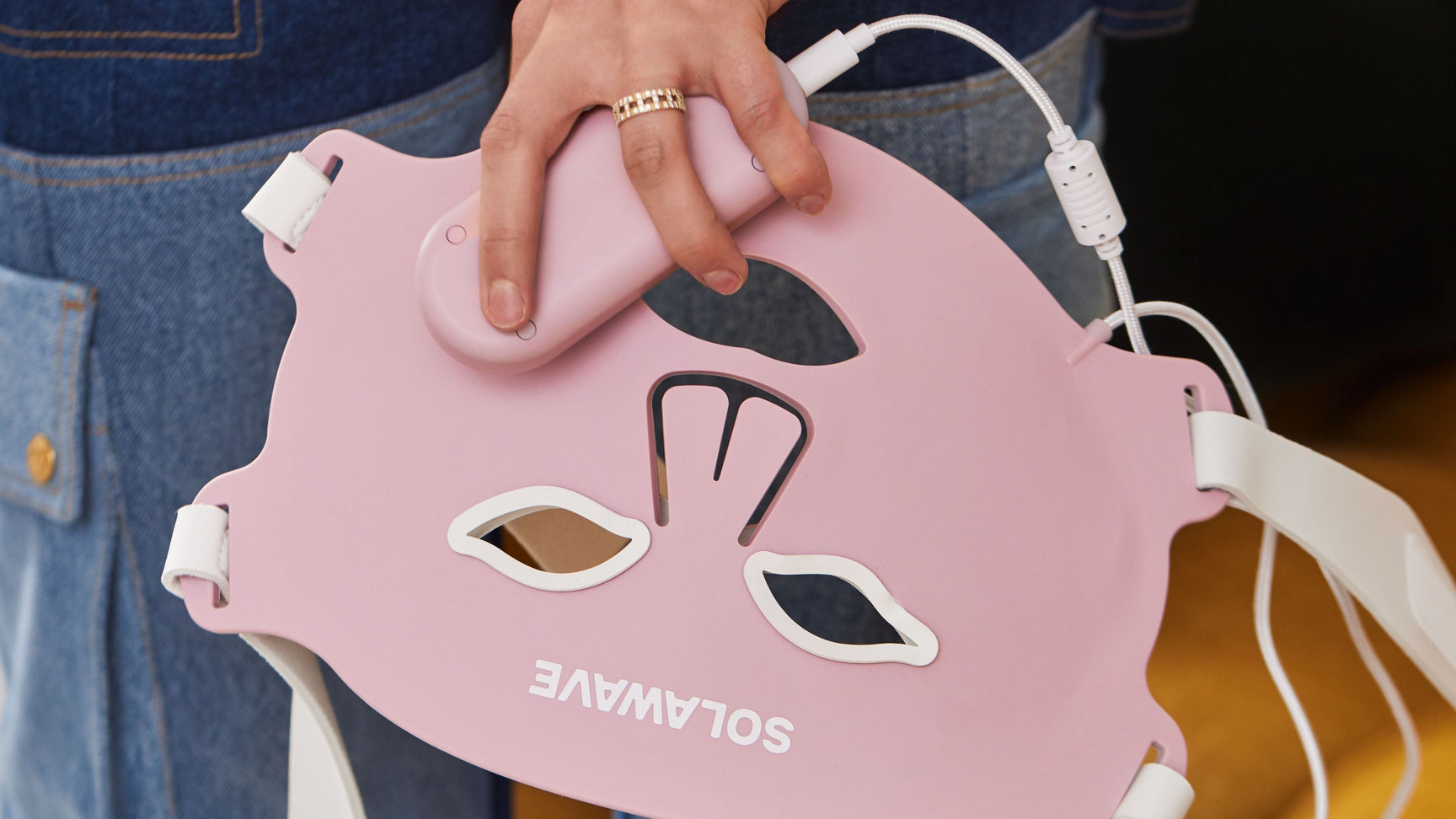
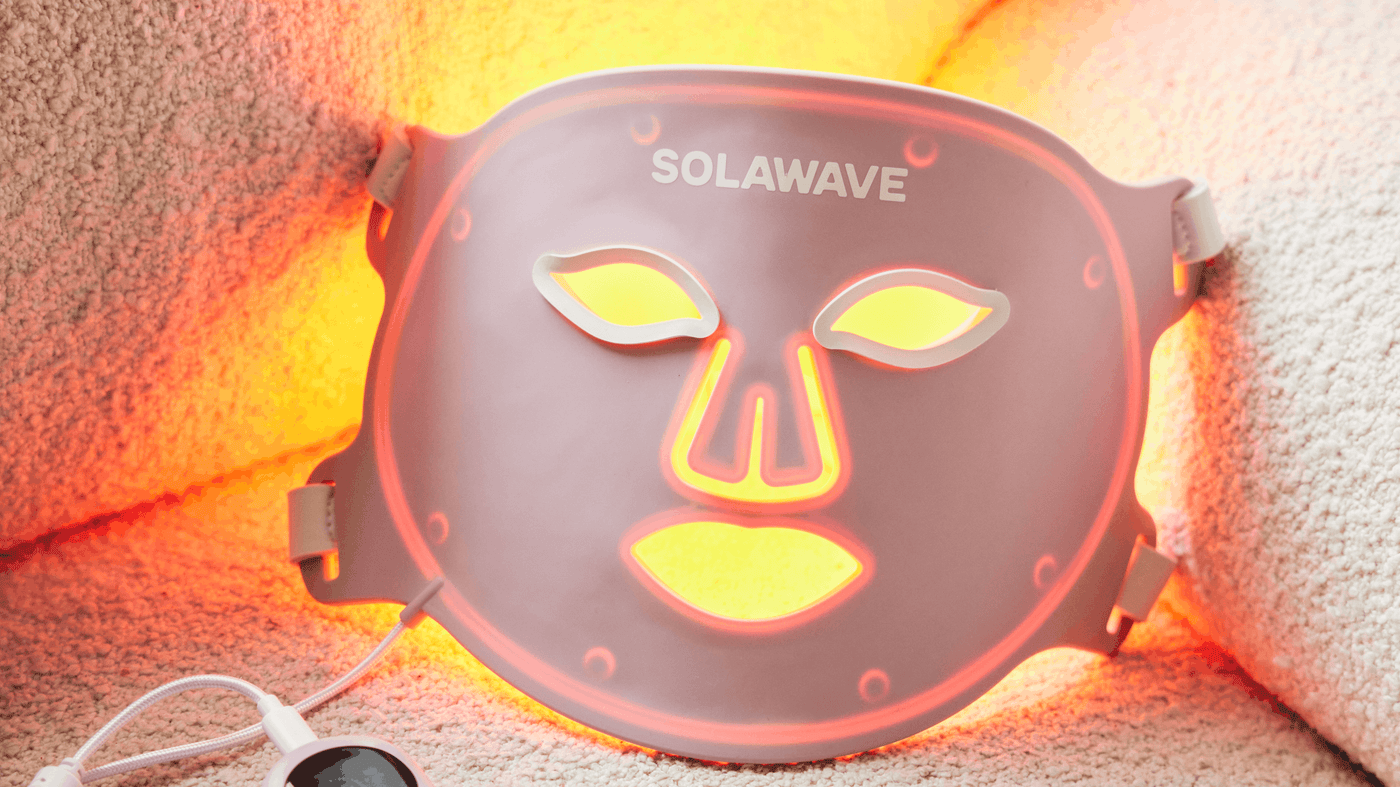
If you'd rather treat your entire face at once, hands-free, an LED mask delivers edge-to-edge coverage with zero effort. The Wrinkle Retreat Pro LED Face Mask uses 320 dual-core LEDs across four therapeutic wavelengths. Red (630nm) and deep red (660nm) support collagen and elasticity. Amber (605nm) calms redness and evens tone. Near-infrared (830nm) goes deepest to support circulation and tissue repair.
With a total irradiance of 65 mW/cm², it's one of the most powerful at-home LED masks available. Each session takes just 3 minutes, and the battery holds a charge for up to a month. It's FDA-cleared, backed by independent clinical studies, and made from soft, medical-grade silicone.
For beginners or anyone who wants a compact option they can take anywhere, the Solawave 2-in-1 Skincare Mini combines red light (630nm) and near-infrared (830nm) therapy with therapeutic warmth. It's collapsible, rechargeable, and comes with a storage bag. Three minutes per area, 12 minutes total.
Not sure which device matches your goals? This breakdown of the best Solawave device for your skincare goals can help you narrow it down.
A few red flags to watch for when evaluating handheld red light therapy devices.
If a device doesn't specify exact wavelengths in nanometers, that's a problem. "Red light" without a number could mean anything. Look for devices that clearly state 630nm, 660nm, or 830nm.
Red light therapy is backed by real science, but it's not a miracle. Any device claiming to "erase" wrinkles overnight or "cure" skin conditions is overselling. Look for brands that cite clinical evidence and use appropriate language about visible results over time.
The most effective handheld devices combine multiple technologies. A device that only delivers low-power red light without any complementary mechanism is going to be limited in what it can achieve.
This is one of the most important questions to ask, and the answer is yes. Red light therapy targets mitochondria, not melanin. Unlike lasers or IPL treatments that carry risks of burns or hyperpigmentation in darker skin tones, red light works with the same cellular mechanism in every skin type. It's safe and equally effective across all Fitzpatrick skin types, from I to VI.
Solawave devices are FDA-cleared, clinically tested, non-UV, and non-invasive. They're also backed by a 60-day money-back guarantee and a 1-year warranty, so there's no risk in trying.
Shop all Solawave devices and find the one that fits your skin, your goals, and your life.
Results may vary. Individual results are not guaranteed.
Red light at 630nm is one of the most clinically studied wavelengths for skin rejuvenation, supporting collagen production and visibly reducing fine lines. Near-infrared at 830 nm penetrates deeper for circulation and cellular renewal.
Most devices are designed for use 3 to 5 times per week. Consistency is key. The Solawave 4-in-1 Skincare Wand takes just 12 minutes per full-face session, and the Pro Face Mask takes 3 minutes.
Yes. Red light therapy targets mitochondria, not melanin, making it safe and effective for all Fitzpatrick skin types from I to VI with no risk of burns or hyperpigmentation.
Galvanic current delivers a steady direct current that drives serum actives deeper into the skin for enhanced absorption. Microcurrent sends electrical impulses to stimulate facial muscles. The Solawave 4-in-1 Wand uses galvanic current, not microcurrent.
If the device uses galvanic current technology, yes. A water-based conductive serum is required for the galvanic current to function. The LightBoost Wand Activating Serum is formulated specifically for this purpose.
Not all of them. Always check for FDA clearance before purchasing. Solawave devices are FDA-cleared, confirming they've been reviewed for safety and efficacy for consumer use.
 Red Light Therapy
 Red Light Therapy