Rated 4.7 out of 5 stars
4.7 / 5


726,000+ customers
Free 60-Day Returns
1-Year Warranty
726,000+ customers
Free 60-Day Returns
1-Year Warranty
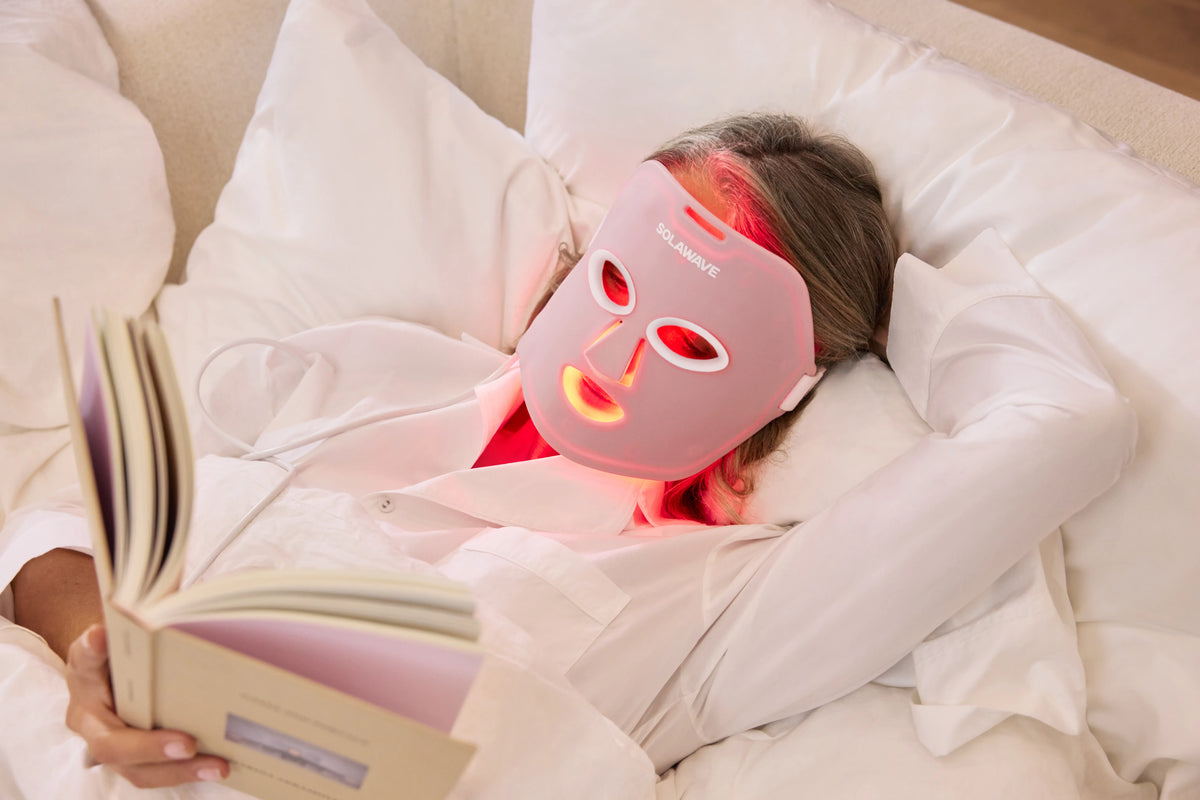
Short answer: yes, within limits. Red light therapy has measured effects on collagen and skin texture in controlled studies. The changes are modest and cumulative, not the dramatic single-session results a laser or an injectable delivers. It works if you use it consistently and set your expectations to match what the research actually shows.
That is the honest version, and it is more useful than either the hype or the dismissal. Here is what an LED mask does, what the evidence supports, where the skeptics are right, and where an at-home device fits next to everything else you might already use.
Red light therapy, also called photobiomodulation, uses specific red and near-infrared wavelengths, roughly in the 600 to 850 nm range. The light is absorbed by chromophores inside the mitochondria, the part of the cell that makes energy. That absorption increases cellular energy production, which activates fibroblasts, the cells that build collagen and support repair.
No heat injury, no wounding, no downtime. That gentleness is the point, and it is also why the effects are gradual rather than dramatic.
The mechanism is well described, and several controlled studies show real, measurable outcomes.
A controlled trial published in Photomedicine and Laser Surgery measured intradermal collagen density, not just how people felt about their skin, and found improvement in the treated group along with a visible reduction in the look of fine lines. A randomized trial in Photobiomodulation, Photomedicine, and Laser Surgery reported a reduction in periocular wrinkle volume, one of the harder outcomes to move at the eye area. A broader review in the Journal of Clinical and Aesthetic Dermatology describes consistent effects on collagen, wound healing, and acne across the wider literature.
The honest caveats belong right next to those results. Sample sizes in this research are often small, in the dozens rather than the thousands. Much of it focuses on facial skin under controlled conditions. Effect sizes are real but modest, and individual results vary. None of that means the therapy does nothing. It means the right expectation is steady, cumulative improvement, not a dramatic overhaul.
Used at the cadence the studies are built on, three to five sessions a week, an LED mask delivers a specific, realistic set of outcomes:
Radiance and surface hydration: within one to two weeks of consistent use.
Calmer redness: useful for reactive or easily flushed skin.
A modest collagen response over eight to twelve weeks: measurable in studies, visible as softer fine lines and better firmness.
Faster recovery after procedures: it supports healing after treatments like microneedling or fractional laser.
That is the scope. Modest, cumulative, low downtime, low cost per session.
An LED mask does not relax a muscle, add volume, or resurface skin in a single session. It will not do what a $4,000 laser course does, and it will not replace a prescription retinoid.
The most useful way to think about it: each tool owns a different job. Daily and weekly, light therapy sits alongside sunscreen, vitamin C, and your retinoid. Quarterly to yearly, in-office lasers, microneedling, or injectables do the heavier structural work. For the modality-by-modality detail, Solawave breaks down how it compares to a retinoid routine and to other treatments. The short version is that they complement each other; none replaces the others.
Editorial outlets have run cautious coverage of at-home LED masks for years. The general line is that the evidence is modest, in-office is stronger, and expectations should be calibrated.
That position is fair, and it is not a refutation. It is the same thing the research says: an LED mask delivers modest, cumulative improvement, not single-session change. Walk in expecting a device to erase deep wrinkles and you will be disappointed. Walk in expecting steadier surface quality, calmer skin, and a tool you actually use several times a week, and you will get what it is built to deliver.
Beyond the published literature, Solawave commissioned an independent study of its Wrinkle Retreat Pro Face Mask, graded by a dermatologist with instrumental measurement across 32 participants. At eight weeks, 100% of participants showed improved skin firmness and elasticity, measured up to 16.7% for firmness and 14.9% for elasticity, and dermatologist grading recorded a visible reduction in the look of fine lines and wrinkles. In the paired perception survey, 94% said they would recommend the mask.
Those are perception and expert-graded results on a small panel, framed the way the research above should be read: real, measured, and modest. If you want a device that publishes its numbers rather than hiding them, the Wrinkle Retreat Pro is FDA-cleared, runs four wavelengths at 65 mW/cm2 in a three-minute session, and is backed by a 60-day return window.
Which wavelengths work best
Red light and retinol purging
It does something. Controlled studies show measurable improvements in collagen density, texture, and inflammatory response over eight to twelve weeks. The improvements are smaller per session than a laser or a retinoid, which is why consistency is what makes the cumulative effect add up.
Radiance and hydration in one to two weeks, texture and tone by weeks three to four, and softer fine lines by weeks six to twelve, with three to five sessions a week. If you are at week four and underwhelmed, you are between phases. Stay consistent and reassess at week eight.
Different mechanism, different job. A retinoid drives cell turnover, and its effect size for wrinkles is larger. Light therapy drives cellular energy and fibroblast activity. They work well together, and neither replaces the other.
If you want dramatic per-session change and can absorb the cost and downtime, in-office laser is the higher-impact option. If you want consistent daily support with no downtime, an LED mask is built for that role. Many people do both.
They are real but come from small trials, mostly on facial skin. That is worth knowing. The honest read is that the therapy produces modest, measurable improvement, which is exactly what a gentle, no-downtime tool should be expected to do.
The wavelengths are generally considered safe across the Fitzpatrick scale when used as directed. If you have an active medical skin condition, check with a dermatologist before starting.
 Skincare Devices