Rated 4.7 out of 5 stars
4.7 / 5


726,000+ customers
Free 60-Day Returns
1-Year Warranty
726,000+ customers
Free 60-Day Returns
1-Year Warranty
Three in-office LED facials cost more than an at-home LED mask used for an entire year. That is the math at the center of this post, and the rest follows from there.
Two ways to get light therapy: a trained esthetician in a clinic or spa, charging $150 to $300 per session, six to twelve sessions over a few months; or an FDA-cleared device at home, $399 once, three to five sessions a week, for as long as the device lasts.
Editorial coverage tends to default to “in-office is stronger, at-home is fine for maintenance.” That framing is technically true and practically misleading. What actually matters is what the cost looks like across a course of treatment, and whether the cadence you can sustain matches the cadence the published research is built on. Here are the numbers.
In-office LED facials cost roughly $150 to $300 per session. A typical course is 6 to 12 sessions over 3 months; total spend ranges from about $900 to $3,600 for that course.
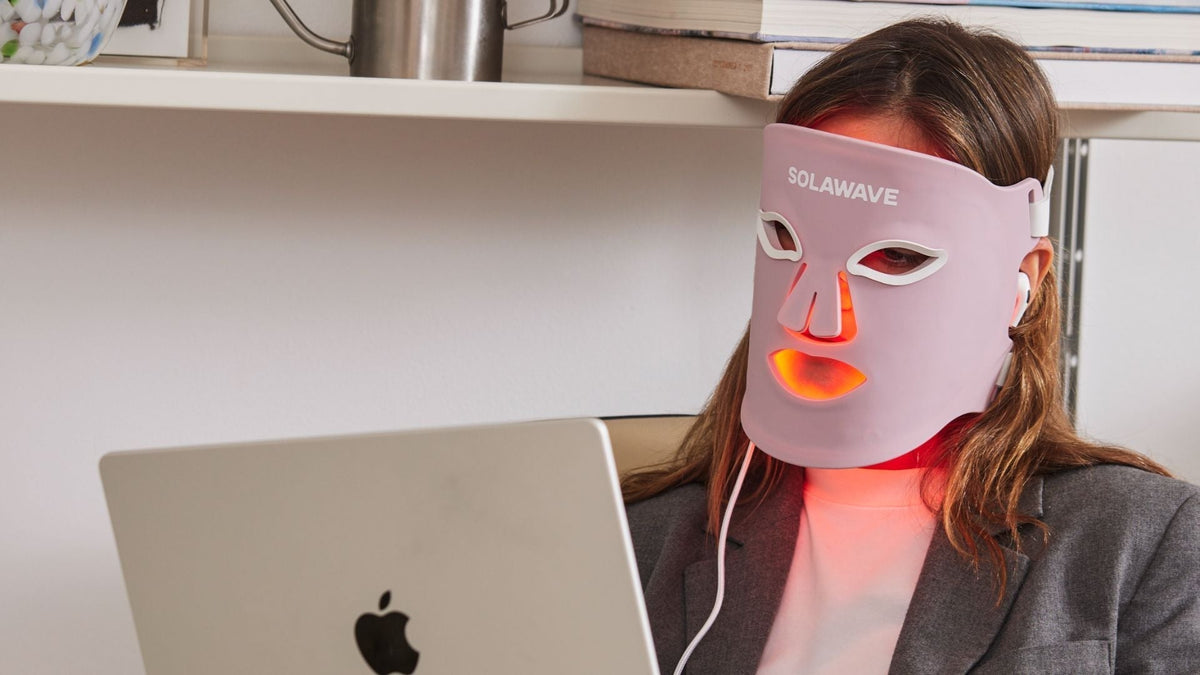
A Solawave Wrinkle Retreat Pro Face Mask costs $399, used 3 to 5 times a week. Over a year that is roughly 156 to 260 sessions; cost per session lands at $1.50 to $2.55.
Breakeven happens fast. A single $399 device pays for itself versus 2 to 3 in-office sessions.
In-office equipment runs higher irradiance, and trained operators read your skin's response in real time. That is a real advantage for a defined course of treatment and for users new to LED therapy.
At-home wins on consistency. The biological benefit of LED therapy compounds with repeated exposure. A device you actually use 3 times a week outperforms a 10-session in-office course you book once and don't return to.
The pricing varies more than most categories. In 2026 the typical at-spa or at-derm LED facial in the US falls in a few bands:
Standalone LED facial at a wellness spa: roughly $75 to $150 per session. Lower-end pricing; usually a single LED panel session with limited prep work.
LED facial as part of a treatment menu at a med spa: roughly $150 to $250 per session. Includes cleanse, mask, and post-care. Often packaged.
LED facial at a board-certified dermatology office: roughly $200 to $300 per session. Highest pricing; usually paired with extractions, microdermabrasion, or other in-office modalities.
A typical recommended course is 6 to 12 sessions over 3 months. At the midpoint ($200 per session) and a 9-session course, that comes to $1,800 total.
After the initial course, most providers recommend maintenance sessions every 4 to 6 weeks. At $200 per maintenance session, that adds roughly $1,800 to $2,600 per year.
The math goes the other direction.
A Solawave Wrinkle Retreat Pro Face Mask is $399 (one-time purchase). It is FDA-cleared as a Class II medical device (510(k) K252983) and is designed for 3 to 5 sessions per week.
If you use it 3 times a week:
Year 1: 156 sessions. Cost per session = $399 / 156 = $2.55.
Year 2: another 156 sessions. Cumulative cost per session = $399 / 312 = $1.28.
If you use it 5 times a week:
Year 1: 260 sessions. Cost per session = $399 / 260 = $1.53.
Year 2: cumulative cost per session = $399 / 520 = $0.77.
Add a topical from the Solawave LightBoost line, like the LightBoost Face & Neck Serum at $56, applied before your session. Even with topical replenishment, the per-session cost stays well under $5.
Both approaches recommend roughly 3 sessions per week. Over 12 weeks, that is 36 sessions in either modality.
|
Modality |
Per session |
36 sessions total |
|
In-office LED facial (low end) |
$150 |
$5,400 |
|
In-office LED facial (mid) |
$200 |
$7,200 |
|
In-office LED facial (high end) |
$300 |
$10,800 |
|
Solawave Wrinkle Retreat Pro Face Mask at home |
~$11.08 ($399 / 36) |
$399 |
After 36 sessions you have either spent $5,400 to $10,800 on in-office care or $399 on a device you can keep using. After another 36 sessions (24 weeks total), the in-office tally is $10,800 to $21,600. The at-home tally is still $399, and the per-session cost on the device has now dropped to roughly $5.54.
This is the part most “at-home is just as good” articles tend to skip. Some things are still better in a clinic.
Higher peak irradiance on professional equipment. Clinical LED panels can run higher peak irradiance than at-home masks, so the total dose delivered in a single session may be higher.
Trained operator response. An esthetician or dermatologist can read your skin in real time and modify the session. If you have a reaction, they catch it. If your skin is changing in unexpected ways, they adjust.
Combination treatments. In-office sessions are often paired with extractions, peels, microdermabrasion, or topical actives delivered with iontophoresis. The LED is one piece of a multi-modal session.
Accountability. If consistency is a problem, a paid appointment forces the session.
For someone who is new to LED therapy, has specific skin conditions a dermatologist is already treating, or wants a curated multi-modal session, in-office still has real value.
Without consistency, LED therapy does not deliver the results the research describes. Three to five sessions a week is what the published photobiomodulation literature is built on, and that cadence is what the at-home device makes possible.
Consistency. Three to five sessions a week is hard to maintain at $200 a session and easy to maintain at home. The at-home device is what turns LED therapy into an actual routine instead of an occasional appointment.
Cost per session. $1.50 to $2.55 at home versus $150 to $300 in office. Two orders of magnitude.
Routine integration. A 3-minute session before bed or while you make coffee is easier to sustain than a calendar appointment.
Maintenance over years. The biological benefit of LED therapy compounds with continued exposure. Sustained use over multiple years is where the long-tail results live, and that is only economically realistic at home.
If you are choosing one or the other, the math weights heavily toward at-home for most people who are reading this post:
You will get more total sessions for less money.
You will hit the consistency cadence the science is built on.
You will not be limited to whatever modality your clinic happens to offer.
If you are choosing to do both, the smarter sequencing is to use an in-office course for the first 4 to 6 sessions if you are new to LED therapy or have a specific condition (acne, melasma, post-procedure recovery) where an operator's eye is valuable. Then transition to at-home for the maintenance phase. The breakeven on the device shows up after 2 to 3 maintenance sessions you no longer need.
If you are choosing in-office only, you are paying for what amounts to a $150 to $300 wellness ritual. There is nothing wrong with that. It just is not a treatment-frequency-driven approach to LED therapy.
In-office LED facials are valuable when you need an operator's eye, a higher peak dose for a defined course, or a multi-modal session that includes LED as one component.
For everyone else who wants the consistent 3-to-5-sessions-a-week cadence that LED photobiomodulation is built on, at-home FDA-cleared devices win on math. A $399 Solawave Wrinkle Retreat Pro Face Mask pays for itself in roughly 2 to 3 in-office visits. Past that point, the cost per session at home is an order of magnitude cheaper than the same number of sessions at a clinic.
The actual in-office versus at-home question is not “which is stronger per session.” It is “which can I afford to do at the cadence the science actually requires?” For most people, the answer is at-home.
Solawave was built around the idea that light therapy should fit into a normal life. The Wrinkle Retreat Pro Face Mask delivers a 3-minute session, FDA-cleared as a Class II medical device (K252983), with 320 LEDs across 4 wavelengths, at the cadence (3 to 5 times per week) the published photobiomodulation research is built on. For more targeted work, the 4-in-1 Radiant Renewal Skincare Wand pairs light therapy with three other modalities for the spots a mask cannot reach. The Neck & Chest Pro Mask extends the same therapy to the area face masks ignore. All FSA/HSA-eligible at checkout, backed by a 60-day return window, and trusted by 726,000-plus customers.
Is an in-office LED facial really stronger than at-home?
Per single session, clinical equipment can run higher irradiance and a trained operator may run a longer, more targeted session. Over a course of treatment, the gap closes quickly because at-home users can hit 3 to 5 sessions per week versus 1 to 2 in office. Cumulative dose typically favors consistent at-home use.
How many in-office sessions equal a year of at-home use?
Roughly: 3 in-office sessions a year at $200 each is $600, versus one $399 at-home device used 156 to 260 times. By session count, year-one at-home is roughly 50 to 80 times more sessions for less money.
Are at-home devices FDA-cleared the same way as in-office equipment?
Yes. Most consumer LED face masks (including the Solawave Wrinkle Retreat Pro Face Mask, cleared under 510(k) K252983) are FDA-cleared as Class II medical devices. The same regulatory pathway covers many in-office systems. Solawave's guide to FDA-cleared skincare devices walks through how clearance works.
What if I want both?
The sequence that makes sense for most users: 4 to 6 in-office sessions if you are new to LED therapy or have a specific condition (acne, melasma, post-procedure care) where an operator's eye is valuable. Transition to at-home for maintenance once you know how your skin responds. The device pays for itself in 2 to 3 in-office visits you no longer book.
Will my insurance or FSA cover at-home LED therapy?
FSA and HSA accounts often cover FDA-cleared medical devices including LED masks, sometimes requiring a Letter of Medical Necessity from a doctor. Solawave is FSA/HSA-eligible at checkout. Standard health insurance generally does not cover cosmetic LED therapy in or out of office.
What if my device needs service?
Solawave's Wrinkle Retreat Pro Face Mask carries a manufacturer warranty. Register your device at purchase to activate it. If anything comes up inside the warranty window, the brand replaces or repairs the device.
Does at-home work for serious skin conditions like cystic acne or melasma?
For maintenance and surface improvement, at-home is sufficient. For active medical conditions a board-certified dermatologist is treating, in-office is still the right modality. The at-home device complements clinical care; it does not replace it. Solawave's safety guide for darker skin tones and Fitzpatrick scale guide cover safety considerations for specific skin types.