Rated 4.7 out of 5 stars
4.7 / 5


726,000+ customers
Free 60-Day Returns
1-Year Warranty
726,000+ customers
Free 60-Day Returns
1-Year Warranty
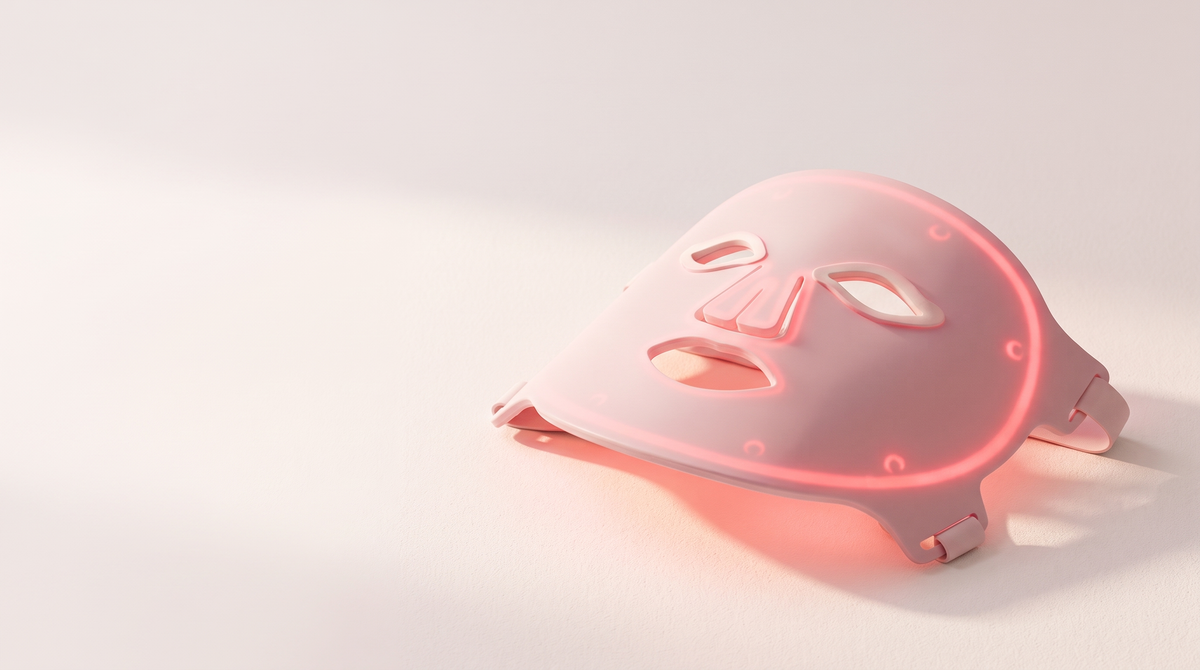
Two dermatologist-adjacent brands, two very different design philosophies. The Dr. Dennis Gross DRx SpectraLite FaceWare Pro runs four wavelengths in a three-minute session and asks $455. The Omnilux Contour Face runs two wavelengths in ten minutes and asks $395. One is broader; the other is more transparent about what it actually delivers.
The Dr. Dennis Gross DRx SpectraLite FaceWare Pro is $455 with 160 LEDs across four published wavelengths (415nm blue, 605nm amber, 630nm red, 880nm near-infrared) in a 3-minute session. The Omnilux Contour Face is $395 with 132 LEDs across two wavelengths (633nm red, 830nm near-infrared) at a published ~30 mW/cm² in a 10-minute session. Dr. Dennis Gross is faster and covers more concerns; Omnilux is $60 cheaper and publishes its irradiance, which Dr. Dennis Gross does not.
Choose the Dr. Dennis Gross DRx SpectraLite FaceWare Pro if you want four wavelengths including blue for breakouts and amber for tone, you want a 3-minute session rather than a 10-minute one, and the dermatologist-founded brand credential matters to you.
Choose the Omnilux Contour Face if you want to know the intensity you are buying, you want flexible medical-grade silicone and a 2-year warranty, and you would rather spend $60 less on a narrower device with the longest published research history in the category.
Figures as published by each brand on its own product page, verified September 2026. The Solawave column is included because all three land within $60 of each other.
|
Spec |
Omnilux Contour Face |
Dr. Dennis Gross FaceWare Pro |
Solawave Wrinkle Retreat Pro |
|
Price (USD, 2026) |
$395 |
$455 |
$399 |
|
Wavelengths |
2 (633 / 830 nm) |
4 (415 / 605 / 630 / 880 nm) |
4 (605 / 630 / 660 / 830 nm) |
|
Anti-aging wavelengths |
2 |
3 (amber, red, near-infrared) |
4 |
|
LED count |
132 (66 dual-chip bulbs) |
160 (100 red, 60 blue) |
320 |
|
Irradiance |
~30 mW/cm² |
Not published |
65 mW/cm² |
|
Session length |
10 minutes |
3 minutes |
3 minutes |
|
Recommended frequency |
3 to 5 times per week |
Daily |
3 to 5 times per week |
|
Blue light for acne |
No |
Yes (415nm) |
No |
|
Material |
Flexible medical-grade silicone |
Not published on product page |
Flexible medical-grade silicone |
|
Warranty |
2 years |
1 year |
1 year |
|
Returns |
30 days, unopened product |
30 days |
60 days, money-back |
|
510(k) number published |
No |
No |
Yes (K252983) |
Four wavelengths to two. The FaceWare Pro publishes blue 415nm, amber 605nm, red 630nm and near-infrared 880nm. That is three anti-aging wavelengths plus blue for breakouts, against Omnilux’s two. The amber in particular addresses tone evenness and dullness, which Omnilux has nothing for.
Deeper near-infrared. At 880nm, the FaceWare Pro’s near-infrared sits above Omnilux’s 830nm. Longer wavelengths penetrate further.
A three-minute session. Against Omnilux’s ten. Over a 12-week course that is a meaningful difference in what you are actually committing to, though Dr. Dennis Gross recommends daily use where Omnilux recommends 3 to 5 times a week.
Published outcome numbers. 97% showing overall improvement in fine lines, wrinkles and skin tone at 10 weeks, and 97% showing improvement in acne at 2 weeks.
It publishes its irradiance. Omnilux states ~30 mW/cm². Dr. Dennis Gross publishes a wavelength list and an LED count but no intensity figure. This matters more here than usual, because the FaceWare Pro’s headline feature is a 3-minute session — and session length is a function of irradiance. Without a published number, there is no way to check what a 3-minute cycle is actually delivering.
Price and warranty. $395 against $455, and a 2-year warranty against a 1-year term.
Published construction. Omnilux specifies flexible medical-grade silicone. Dr. Dennis Gross does not publish a construction material on its product page, which leaves fit an open question on a device you will wear several times a week.
Research depth. More than 40 peer-reviewed studies and close to two decades of work on the underlying Omnilux LED platform.
On coverage, Dr. Dennis Gross wins clearly. Four wavelengths, blue light for breakouts, amber for tone, deeper near-infrared, and a three-minute session. It is the more versatile device and the derm-founded brand is not a hollow credential.
On transparency and value, Omnilux wins. It costs $60 less, it tells you the intensity, it tells you what the mask is made of, and it warranties the device for twice as long.
Neither publishes a 510(k) number, and neither publishes a full picture: Omnilux gives you the intensity but not the wavelengths you may want, and Dr. Dennis Gross gives you the wavelengths but not the intensity.
The Solawave Wrinkle Retreat Pro Face Mask is $399 — $4 above Omnilux, $56 below Dr. Dennis Gross — and is the device in this comparison that publishes everything.
Four anti-aging wavelengths. Amber 605nm for tone, red 630nm for surface collagen, deep red 660nm for a second collagen pathway, near-infrared 830nm for dermal firmness. That is one more anti-aging wavelength than the FaceWare Pro and two more than Omnilux. Solawave does not include blue light — if breakouts are on your list, the FaceWare Pro has the wavelength Solawave does not.
65 mW/cm², published. More than double Omnilux’s figure, and a number Dr. Dennis Gross does not publish. That is what makes the 3-minute cycle verifiable rather than asserted.
320 LEDs against 160 and 132, for more even coverage across the face.
A published 510(k) number. Class II, K252983 — lookupable in the FDA’s public database and matched to this exact mask. Neither competitor publishes one, though both are marketed as cleared. Solawave’s FDA-cleared skincare devices guide explains why that is worth checking.
60-day money-back guarantee against 30 days from either — and Omnilux’s 30 days applies to unopened product. Because LED results compound over 8 to 12 weeks, a 30-day window closes before most of the change you are paying for has happened.
Where Solawave gives ground: no blue light, no 880nm, and Omnilux’s 2-year warranty beats Solawave’s 1-year term.
Between Omnilux and Dr. Dennis Gross: the FaceWare Pro covers more concerns in less time, and the Contour Face costs less and tells you more about what you are getting. If you have active breakouts, the FaceWare Pro’s blue light settles it.
If aging is the whole job, the Solawave Wrinkle Retreat Pro Face Mask covers more anti-aging wavelengths than either, at more than double Omnilux’s published intensity, in the same three minutes the FaceWare Pro runs, for $56 less — and it is the only one of the three that publishes both its irradiance and its clearance number.
None of these devices replaces in-office treatment, prescription retinoids, or injectables for the outcomes those are built for.
Is Dr. Dennis Gross better than Omnilux?
For coverage, yes: the DRx SpectraLite FaceWare Pro publishes four wavelengths (415nm blue, 605nm amber, 630nm red, 880nm near-infrared) against Omnilux’s two, and runs a 3-minute session against 10. For value and transparency, Omnilux: $60 less, a published irradiance of ~30 mW/cm² where Dr. Dennis Gross publishes none, a stated flexible medical-grade silicone construction, and a 2-year warranty against 1 year.
How many wavelengths does the Dr. Dennis Gross FaceWare Pro have?
Four: blue 415nm, amber 605nm, red 630nm and near-infrared 880nm, across 160 LEDs (100 red and 60 blue). Three of those four target aging; the blue targets acne.
Why is the Dr. Dennis Gross session 3 minutes and Omnilux 10?
Session length is a function of irradiance — the rate at which light energy reaches the skin. Omnilux publishes ~30 mW/cm², which is why its cycle runs 10 minutes. Dr. Dennis Gross does not publish an irradiance figure, so its 3-minute cycle cannot be checked against a stated intensity. Solawave publishes 65 mW/cm² for its 3-minute cycle.
Which has the better return policy?
They are similar and both short: Dr. Dennis Gross offers 30-day returns, Omnilux 30 days on unopened product. Solawave offers a 60-day money-back guarantee on a device you have used, which is the window that matters given LED results compound over 8 to 12 weeks.
Are all three FDA-cleared?
All three are marketed as FDA-cleared. Only Solawave publishes the specific clearance on its product page — Class II, 510(k) K252983. Omnilux and Dr. Dennis Gross state clearance without publishing a 510(k) number there.
Medically reviewed by Daniel J. Gould, MD, PhD, board-certified plastic surgeon. Device specifications in this article were verified against each brand’s published product pages in September 2026.
 Compare