Rated 4.7 out of 5 stars
4.7 / 5


726,000+ customers
Free 60-Day Returns
1-Year Warranty
726,000+ customers
Free 60-Day Returns
1-Year Warranty
You usually notice it before anyone says anything. Your face still looks fine, maybe better than it did five years ago, because you finally figured out retinol and daily sunscreen. Then you catch the skin between your collarbones in a certain light. Horizontal lines. A faint crepe under the jaw. The face kept up with your routine. The neck and chest did not.
This is not aesthetic anxiety, it is anatomy. Tech neck names what happens when years of looking down at a screen meet skin that was already structurally vulnerable. Here is why the area ages first, and what light therapy can and cannot do about it.
Tech neck is the set of horizontal lines and sagging that come from chronic forward head posture and screen time. The label is informal, the underlying changes are documented in dermatology.
Neck and chest skin ages faster because it is thinner and has fewer oil glands. It loses moisture quickly, gets less consistent sunscreen, and creases where you fold it looking down.
Light therapy supports collagen on the neck and chest the same way it does on the face. Wavelengths are absorbed by the mitochondria, which drives the cellular energy that activates collagen-producing fibroblasts.
Results here run a little slower than on the face. Expect six to twelve weeks of consistent use before visible texture change, because the skin is thinner and the damage is often deeper.
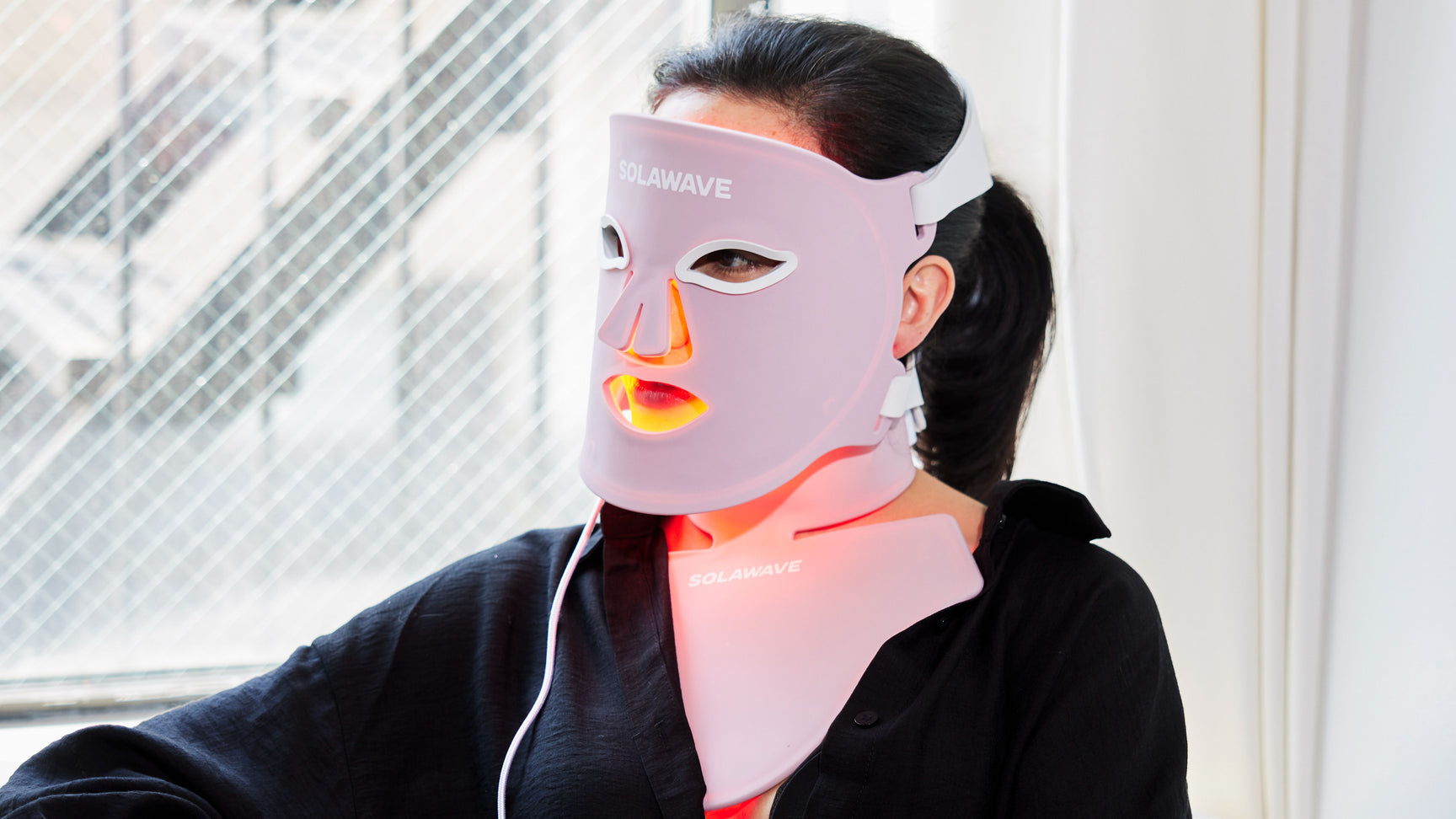
Very few brands build for this area. The Neck & Chest Pro Mask is one of the only dedicated neck-and-chest LED masks in the category.
The skin below your jaw is built differently from the skin on your face, and every difference works against it.
It is thinner, with fewer sebaceous glands. Less oil means less natural moisture retention and a surface that crepes more easily. Cleveland Clinic notes that neck skin is naturally thinner than facial skin and tends to show age sooner.
It gets less sun protection. Most people apply sunscreen to the face and stop at the jaw. The sides of the neck and the upper chest collect years of daylight exposure, much of it through car windows, with little defense.
It gets folded, over and over. Forward head posture over a phone or laptop creases the same lines repeatedly, the way frowning creases the space between your brows. Sleeping on your side compounds it.
Put those together and the visible timeline on the neck and chest tends to run ahead of the face, especially between the mid-thirties and mid-fifties.
The term is recent, the changes underneath it are not. Dermatology has names for all of them.
Horizontal neck lines: one to three creases across the front of the neck that deepen with repeated forward flexion.
A softer jawline: as the platysmal muscle and dermal support weaken together.
Crepey texture on the chest: from cumulative sun exposure and collagen loss across the decollete.
Uneven pigment: patches on the side of the neck and across the chest from chronic daylight.
Light therapy works on the underlying mechanism of collagen loss rather than the surface. Specific red and near-infrared wavelengths are absorbed by chromophores inside the mitochondria, which increases cellular energy production and activates fibroblasts, the cells that build collagen.
The evidence for that pathway is measured, not assumed. In a collagen density controlled trial, red and near-infrared light improved intradermal collagen and the look of fine lines. A separate wavelength study using the 633 nm and 830 nm pairing, the same core wavelengths in the category, showed measurable facial skin improvement. On the thinner skin of the neck and chest the same mechanism applies, with a slightly slower visible result.
This is where a dedicated device matters. A face mask is shaped for the face and leaves most of the neck and chest uncovered. The Neck & Chest Pro Mask is contoured for the area a face mask ignores. For the full session-by-session protocol, Solawave's guide to neck and chest sessions walks through cadence and order of operations. The short version: three to five sessions a week, layered after cleansing and before moisturizer, with daily sunscreen on top.
Light therapy is the consistent, low-effort tool that runs alongside the rest of the routine, not a replacement for the two things that prevent new damage.
Sunscreen is still the anti-aging step that does the most work, and it has to reach the neck and chest, not stop at the jaw. Posture still matters, because a device cannot undo eight hours a day of forward flexion at the source. And in-office collagen treatments like radiofrequency microneedling or fractional laser remodel faster when you want a bigger change, at a higher cost and with downtime. Light therapy is the daily driver that maintains and supports all of it.
Adjusted from the published facial timeline for the slightly slower response on thinner skin:
Weeks 1 to 2: surface hydration improves, skin looks a little plumper and less crepey. No structural change yet.
Weeks 3 to 4: texture begins to soften, and horizontal lines may start to look shallower.
Weeks 5 to 8: visible improvement in line depth and more even tone across the chest.
Weeks 9 to 12: a fuller collagen response, with firmer skin along the jaw and softer crepe on the chest.
After twelve weeks, the response stabilizes. Continued use holds the gains; stopping lets the underlying collagen loss pick back up. Although it’s always worth noting that everyone's skin is different and results vary.
Most LED brands treat the neck and chest as an afterthought. Solawave built a dedicated device for it. The Neck & Chest Pro Mask is shaped to contour the area a face mask cannot reach and runs on the same photobiomodulation science as the flagship face mask. Paired with daily sunscreen and a screen-posture check, it targets the area that ages first in people who spent the last decade looking down. FSA and HSA-eligible at checkout, backed by a 60-day return window and a 1-year warranty.
The label is informal, but the changes it describes are documented in dermatology: horizontal cervical lines, weakening of the platysma, and photoaging of the decollete. Tech neck is the shorthand for those changes speeding up in people who spend the day looking down at screens.
It is thinner, has fewer oil glands, and usually gets less sunscreen. It loses collagen earlier and shows surface changes faster than the face does.
A face mask is shaped for the face and leaves most of the neck and chest uncovered, so the light does not reach the area evenly. A device shaped for the neck and chest covers the territory the face mask cannot.
Slightly longer than the face. Surface hydration in one to two weeks, texture and tone by weeks three to four, and visible line softening by weeks six to twelve with consistent use.
Yes, carefully. Retinoids can be more irritating here because the skin is thinner and drier. Start low, two to three nights a week, and build up slowly. Do not use a retinoid in the same session as the mask; space them by at least an hour or alternate morning and night.
Yes. Estrogen decline speeds collagen loss across all skin, including the neck and chest. The light-therapy mechanism runs on cellular energy production and does not depend on estrogen, so it stays useful through that window.
 News
News