Rated 4.7 out of 5 stars
4.7 / 5


726,000+ customers
Free 60-Day Returns
1-Year Warranty
726,000+ customers
Free 60-Day Returns
1-Year Warranty
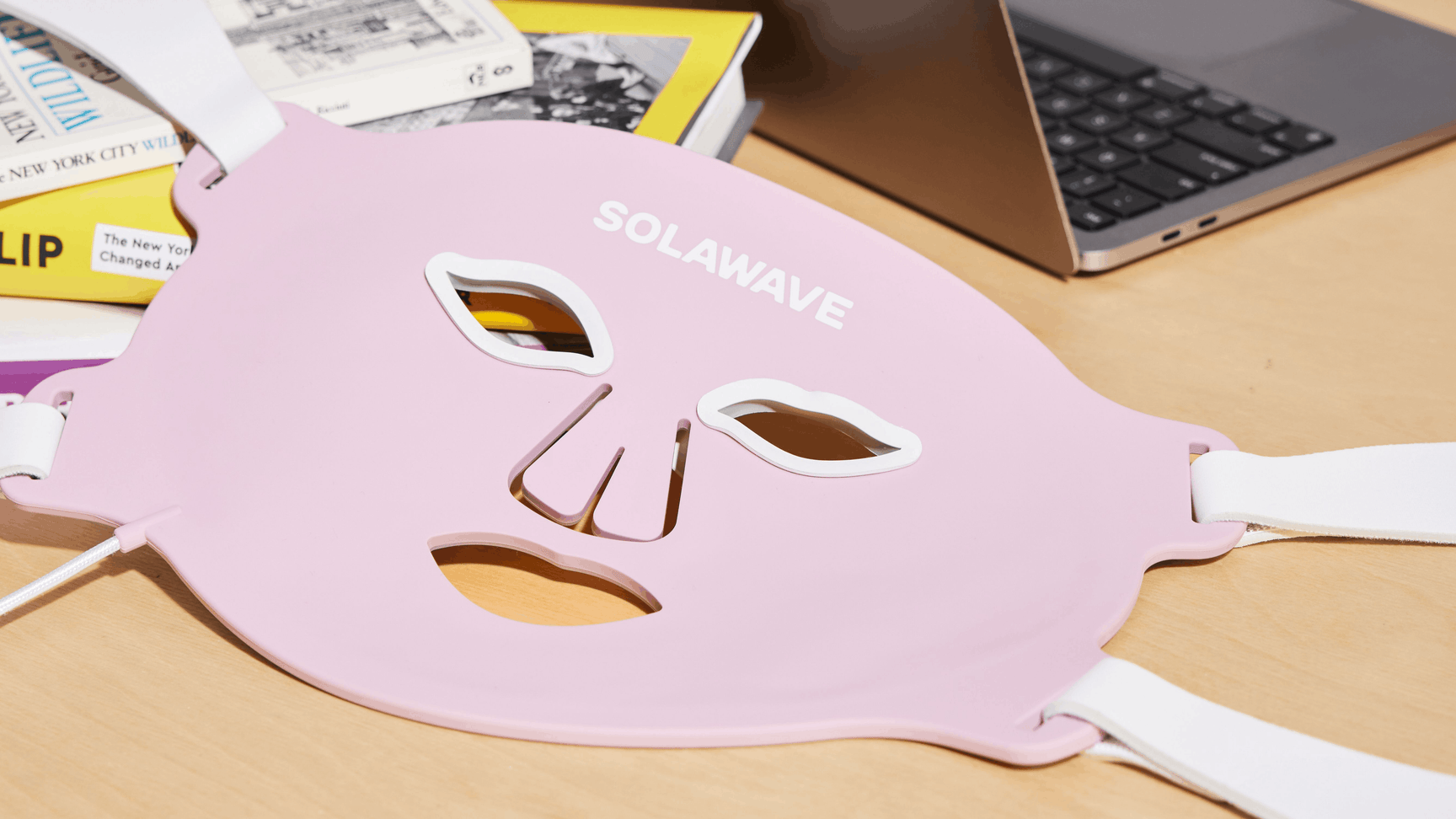
One mask advertises 480 LEDs. Another advertises 320. Which one delivers more light energy to your skin? You cannot tell from the LED count, and that is the whole problem with how these devices get marketed. LED count is the number brands lead with because it is easy to make big. It is also the number that tells you the least about whether a mask works.
Here is how to read an LED face mask spec sheet like someone who knows what the numbers mean, so you can compare two masks on the specs that actually change the outcome.
LED count is coverage, not power. More LEDs can mean more even coverage, but the number on its own says nothing about how much energy reaches your skin.
Irradiance is the number that measures intensity. Measured in mW/cm2, it is the power density delivered to the surface, and it is the spec most masks bury or leave off entirely.
Dose, or fluence, is irradiance multiplied by time. Measured in J/cm2, it is the total energy a session delivers, and more is not automatically better.
Wavelengths are a range, not a color. "Red light" without a number in nanometers is not a specification.
Session time follows from irradiance. A higher-intensity mask reaches a working dose in less time, which is mostly a question of how sustainable the routine is.
Irradiance is how much light power lands on each square centimeter of skin. It is the closest single number to "how strong is this mask." A mask running 65 mW/cm2 is delivering light more intensely than one running 30 mW/cm2. If a product page does not publish irradiance, that is usually a sign the number is not flattering.
Dose is irradiance multiplied by time. Run 65 mW/cm2 for three minutes, and you deliver about 11.7 J/cm2. Run 30 mW/cm2 for ten minutes, and you deliver about 18 J/cm2. Dose is the total energy your skin receives, and here is the part the marketing skips: more is not automatically better. Photobiomodulation follows a biphasic dose response, an Arndt-Schulz curve where too little light does nothing and too much can actually do less. There is a working window, and once a mask reaches it, piling on more energy is not the win it sounds like. The doses in the studies that show real change, like the collagen density study that measured intradermal collagen, sit inside that window rather than above it.
Wavelengths are measured in nanometers, and the therapeutic window for skin sits roughly between 600 and 850 nm. A mask that says "red and infrared light" without numbers has not told you anything you can check. The count of distinct wavelengths matters too, because different wavelengths reach different depths and address different concerns. Two masks can both say "red light" and deliver very different things. A wavelength study using the 633 nm and 830 nm pairing is one reason the specific numbers, not the word "red," are what to look for.
LED count is how many diodes sit in the mask. It affects coverage and how evenly the light lands, so it is not meaningless. It is just not power. A mask with more LEDs at a lower irradiance can deliver less intense light than a mask with fewer LEDs at a higher irradiance. Judge coverage by LED count. Judge strength by irradiance.
Session length is not a spec on its own, it is a consequence of irradiance. A higher-intensity mask reaches a working dose faster, so its session is shorter. The practical value of a short session is adherence: a three-minute routine is far easier to run three to five times a week than a ten-minute one, and consistency is what the research is built on.
LED count is easy to inflate and easy to understand, which is exactly why it leads the marketing. But two masks with wildly different LED counts can deliver similar energy, and two masks with similar LED counts can deliver wildly different energy, because the diode count says nothing about the power each diode puts out or how close it sits to your skin.
Proximity is the quiet variable here. Flexible silicone masks sit against the face, so more of the rated irradiance actually reaches the skin. A rigid mask held a centimeter off the surface loses intensity across that gap, because light falls off with distance. Two masks can publish the same irradiance and still deliver different doses to your face depending on how they fit.
Ignore the hero number on the box and line up the four specs that matter. Take a higher-intensity, short-session mask against a lower-intensity, long-session one:
|
Spec |
65 mW/cm2, 3-minute mask |
30 mW/cm2, 10-minute mask |
|---|---|---|
|
Irradiance |
65 mW/cm2 |
30 mW/cm2 |
|
Session length |
3 minutes |
10 minutes |
|
Dose per session |
11.7 J/cm2 |
18 J/cm2 |
|
Wavelengths |
check the nm list |
check the nm list |
The lower-intensity mask delivers more total fluence, but it takes more than three times as long to do it, and both sit inside the working range where the biphasic curve says extra energy stops adding much. So the real differences come down to intensity, how sustainable the session length is, and how many wavelengths each one covers, not the raw dose number and definitely not the LED count. For a worked, named example of this framework, the Solawave vs Omnilux comparison runs the same four specs side by side.
FDA cleared is a floor, not a ranking. It means the device cleared the 510(k) pathway by showing it is substantially equivalent to a device already on the market for the same use. It tells you the mask met a safety and equivalence bar. It does not tell you the mask is stronger, or better, or more effective than another cleared mask. Every FDA-cleared mask cleared the same bar, so use clearance to rule out uncleared devices, then compare the cleared ones on the specs above. Solawave's guide to FDA-cleared devices covers how the process works.
Before you buy, a credible product page should let you find all five of these in under a minute:
Irradiance in mW/cm2.
Wavelengths as specific numbers in nm.
Session length and recommended weekly cadence.
LED count, for coverage.
FDA clearance, ideally with the clearance number.
If a page publishes the LED count and the price but hides irradiance and the exact wavelengths, treat the missing numbers as the answer. Brands that publish everything are usually the ones whose numbers hold up.
For a sense of what a complete spec sheet looks like, the Wrinkle Retreat Pro publishes all five: four wavelengths (605, 630, 660, and 830 nm), 320 LEDs, 65 mW/cm2 of irradiance, a three-minute session, and FDA clearance under K252983, which works out to about 11.7 J/cm2 per session in the working range. That may or may not be the mask you choose, but it is the level of detail worth demanding from any device before you spend $300 or more.
The LED count is the number brands want you to compare on, because it is easy to make impressive and it hides the specs that matter. Read past it. Irradiance tells you intensity, dose tells you total energy within a working window, wavelengths in nanometers tell you what the light can address, and session time tells you whether you will actually keep it up. Judge a mask on those, and the marketing stops working on you.
Which wavelengths work best
Light therapy panel vs mask
No. LED count affects coverage, not power. A mask with more LEDs at a lower irradiance can deliver less intense light than one with fewer LEDs at a higher irradiance. Compare irradiance for strength and LED count for coverage.
There is a working range rather than a single ideal number, because the dose response is biphasic. Most facial masks sit somewhere between roughly 30 and 100 mW/cm2. What matters more than chasing the highest number is that the mask publishes its irradiance at all, and that the dose per session lands in the working window.
Not necessarily. A longer session usually means a lower irradiance, so the mask needs more time to reach a working dose. The 3-minute mask is running a higher intensity. Both can land in the effective range; the shorter one is easier to keep up with.
Treat the missing number as informative. Irradiance is the spec that separates a real device from a decorative one, and brands that have a strong number tend to publish it. If you cannot find irradiance and specific wavelengths, you cannot actually compare the mask to one that publishes them.
No. Photobiomodulation follows a biphasic curve, so there is a window where the light works and a point past which more energy stops helping and can do less. Once a mask reaches the working range, a bigger dose number is not an advantage.
 News
News