Rated 4.7 out of 5 stars
4.7 / 5


726,000+ customers
Free 60-Day Returns
1-Year Warranty
726,000+ customers
Free 60-Day Returns
1-Year Warranty
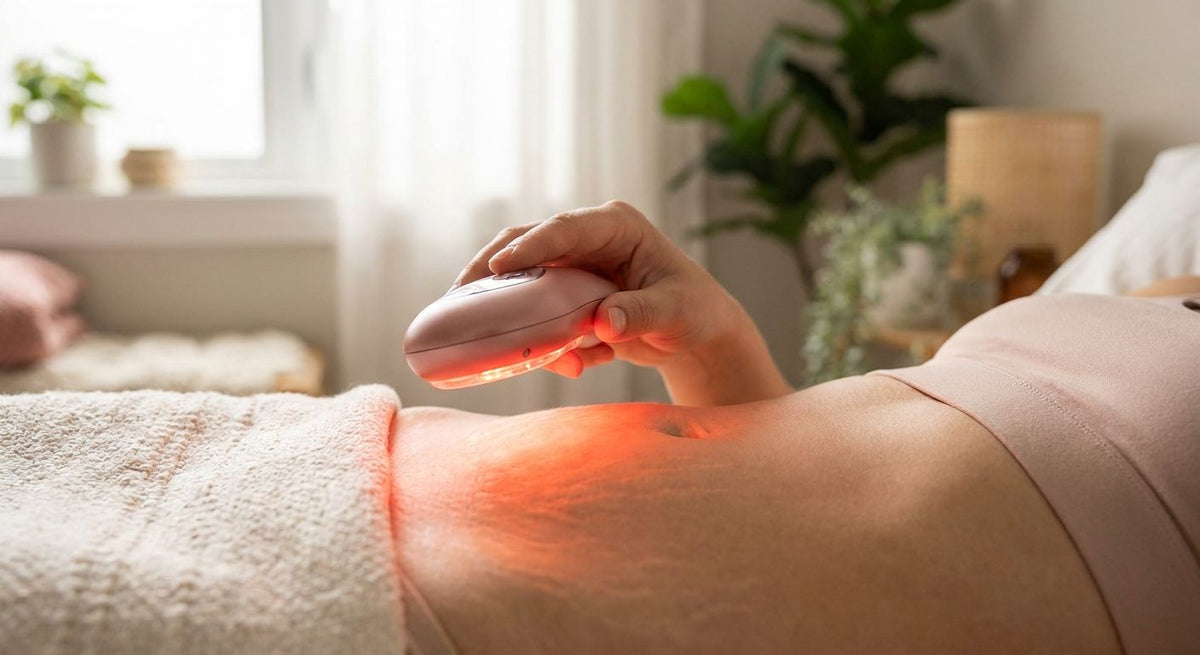
Stretch marks form when skin stretches faster than collagen and elastin can keep up, tearing the dermis and leaving behind those pink, purple, or silvery streaks. Red light therapy for stretch marks uses specific red and near-infrared wavelengths to try to stimulate that same collagen supply from the outside, and this guide breaks down what the research actually supports, what to look for in a device, and where Solawave's FDA-cleared lineup realistically fits in 2026.
Stretch marks (striae) start as striae rubra — reddish or purple lines where blood vessels sit close to the torn dermis — and mature into striae alba, the flatter, whiter version most people are trying to treat years later. Red and near-infrared light in the roughly 630-660nm and 810-850nm ranges are studied in dermatology for their ability to reach fibroblasts and prompt collagen and elastin production, the same mechanism behind at-home red light therapy for wrinkles and scars.
That matters for stretch marks specifically because early, still-red striae respond to interventions that boost collagen turnover more than long-settled white ones do. If your stretch marks are new — a few months old, still pink — you're a better candidate for red light therapy than someone treating marks from a decade ago. That single fact should shape which device you buy and how much you expect from it.
The 4-in-1 Radiant Renewal Skincare Wand is Solawave's most portable red light therapy device at $169, which is worth knowing before you assume you need a full panel mask for this.
This guide is for anyone with existing stretch marks — postpartum, teen growth spurts, weight change, or muscle gain — who wants to try a non-invasive, at-home option before booking a dermatology consult for lasers or microneedling. It's also for anyone already using Solawave for face and neck skincare who's wondering whether the same device does double duty on the body. It is not a guide for anyone expecting a device to erase decades-old white stretch marks in a few weeks; nothing sold in 2026 does that.
Any device worth buying lists its wavelengths, not just "red light" as a marketing word. Red (roughly 630-660nm) works closer to the skin surface, while near-infrared (roughly 810-850nm) penetrates deeper toward the dermis where collagen remodeling happens. If a product page won't tell you what wavelengths it uses, that's a sourcing problem, not a minor detail.
Stretch marks show up on the abdomen, hips, thighs, breasts, and upper arms — areas a face-sized LED panel was never built to treat. A handheld wand you can move across a larger surface, or a mask shaped for a specific zone like the décolletage, matches the reality of where stretch marks form better than a device designed purely for facial skin.
FDA clearance means a device met a specific safety and performance bar for a stated use — it does not automatically mean that use includes stretch marks. Check exactly what a device is cleared for before assuming it covers your situation; a device cleared for facial fine lines and wrinkles is not the same as one cleared for striae.
Collagen remodeling is slow. Studies on red light therapy for skin conditions generally look at 8 to 12 weeks of near-daily sessions before evaluating visible change. Any product promising dramatic fading in days is selling a timeline biology doesn't support.
Peptides, niacinamide, and hyaluronic acid formulated to pair with red light exposure can support the skin barrier while collagen production ramps up. A serum designed to work alongside a light device is a reasonable add-on; it is not a substitute for the light itself.


The portable pick: 4-in-1 Radiant Renewal Skincare Wand. At $169, it's a handheld device built for face, neck, and jawline use, which means it can technically be moved across a larger body surface even though Solawave doesn't market it for stretch marks. If you already want a red light routine for your skin and are curious about adding stretch marks at the margins, this is the lowest-commitment entry point. Verdict: Consider — reasonable if your expectations stay realistic about what it's designed for.
The high-output pick: Wrinkle Retreat Pro LED Face Mask. At $399, it packs 320 LEDs across four wavelength types — red, infrared, deep red, and amber — into a full-face panel. It's built and FDA-cleared for facial skin, not stretch marks on the abdomen or thighs. Verdict: Skip for stretch marks specifically; Buy if your actual goal is facial fine lines and wrinkles.
The décolletage pick: Neck & Chest Pro Light Therapy Mask. At $349, this is the one Solawave device shaped for the chest area, which matters because breast-related and pregnancy-related stretch marks frequently show up right there. It's still not labeled or cleared for stretch marks treatment, but it's the only Solawave panel sized for that zone. Verdict: Consider if your marks sit specifically on the chest or décolletage; Skip if they're on the abdomen, hips, or thighs.
For scar-adjacent skin concerns more broadly, the mechanism overlaps with what's covered in red light therapy for surgical scars — both rely on stimulating collagen remodeling in damaged dermal tissue, just in different contexts.
| Pick | Coverage | Format | Price | Best For | Verdict |
|---|---|---|---|---|---|
| 4-in-1 Radiant Renewal Skincare Wand | Handheld, movable | Wand | $169 | General red light routine, small zones | Consider |
| Wrinkle Retreat Pro LED Face Mask | Full face | Panel mask | $399 | Facial wrinkles, not stretch marks | Skip (for this use) |
| Neck & Chest Pro Light Therapy Mask | Neck and chest | Panel mask | $349 | Décolletage stretch marks | Consider |
Does red light therapy work for stretch marks?
Red light therapy can help fade the appearance of early, reddish stretch marks by stimulating collagen production in the dermis. It's less effective on old, white, fully matured stretch marks, so timing matters as much as the device.
What's the best red light therapy device for stretch marks?
No device on the market in 2026 is FDA-cleared specifically for stretch marks. Handheld wands offer more coverage flexibility across body areas than face-sized panels, which is the main practical difference to look for.
How long does it take to see results from red light therapy on stretch marks?
Most red light therapy research on skin remodeling evaluates results after 8 to 12 weeks of near-daily sessions. Expect gradual fading, not a dramatic change in the first few weeks.
Is red light therapy better than laser for stretch marks?
Lasers work faster and more aggressively on established stretch marks because they're delivered by a dermatologist at higher intensities. Red light therapy is a lower-commitment, at-home option best suited to newer, still-reddish marks.
Can red light therapy fade old white stretch marks?
Old white stretch marks (striae alba) respond less to red light therapy than newer red or purple ones because the tissue has already fully scarred and lost pigment. Consistent use may soften texture slightly, but full fading is unlikely.
Is Solawave FDA-cleared for stretch marks?
Solawave's devices are FDA-cleared for facial and neck skin concerns like fine lines, wrinkles, and acne, not specifically labeled for stretch marks. Check each product page for its stated clearance before assuming it covers your use case.
How often should you use red light therapy for stretch marks?
Most red light therapy protocols call for near-daily sessions of a few minutes per area to see gradual change over months. Skipping days regularly slows down any collagen-related improvement.
How much does an at-home red light therapy device cost in 2026?
At-home red light therapy devices in 2026 range from under $200 for handheld wands to $350-$400 for full panel masks. Price generally tracks with LED count and coverage area, not necessarily effectiveness for a specific body zone.
The detail most people skip: consistency matters more than intensity. A $169 wand used every night for 10 weeks will outperform a $399 mask used twice a month, because collagen remodeling responds to repeated, low-dose stimulation over time, not occasional high-output sessions. Pick the device you'll actually use daily in 2026, not the one with the most LEDs sitting in a drawer.
 Acne
Acne