Rated 4.7 out of 5 stars
4.7 / 5


726,000+ customers
Free 60-Day Returns
1-Year Warranty
726,000+ customers
Free 60-Day Returns
1-Year Warranty
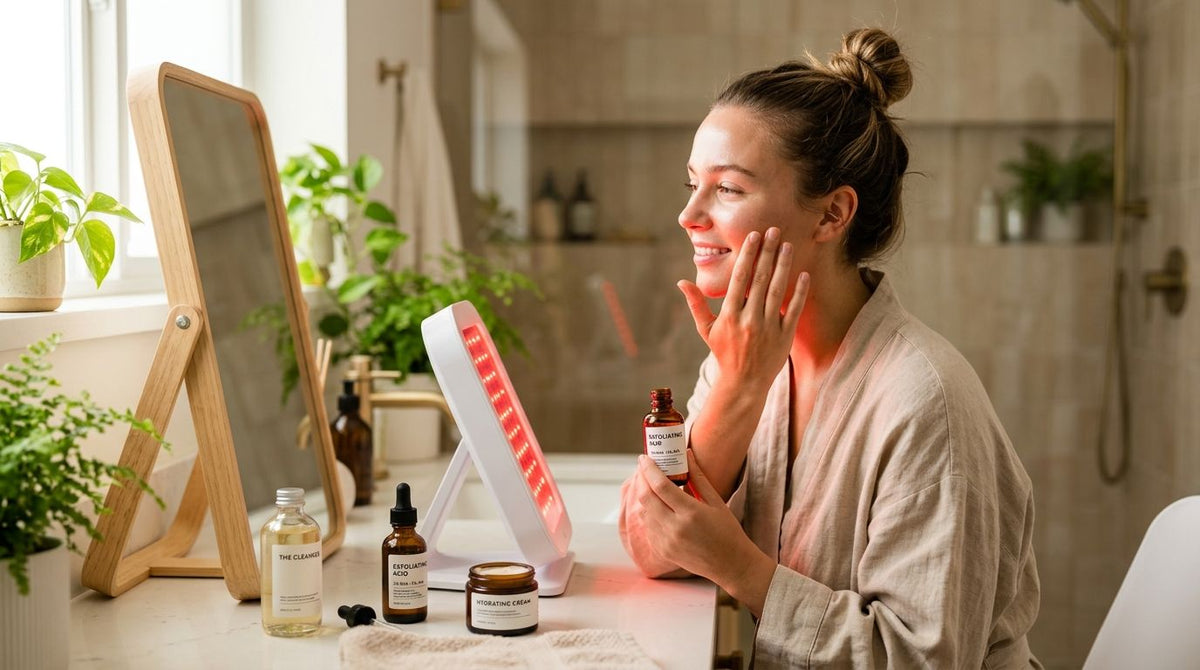
Layer exfoliating acids with red light therapy by applying the acid first, letting it fully absorb for 15 to 20 minutes, then following with your red light session — never apply acid directly under an active LED mask or wand. On nights you use a strong AHA or BHA, treat that as your exfoliation night and save red light for the following evening if your skin runs sensitive or reactive.
The hidden cost most routines miss: exfoliating acids thin the outer skin barrier and increase sensitivity to heat and light for several hours afterward, so stacking a high-percentage acid directly under a warm LED panel can sting or flush skin that would otherwise tolerate both steps fine on separate nights.
Red light therapy and exfoliating acids solve different problems and most people want both in one routine: acids clear dead cell buildup and unclog pores, red light supports collagen signaling and calms inflammation. The mistake isn't using both — it's using them at the same moment on skin that's already stressed.
Devices like the 4-in-1 Radiant Renewal Skincare Wand with Red Light Therapy are built for daily use, which means the acid side of your routine needs its own lane rather than getting layered directly underneath the wand. Get the sequencing wrong for a few weeks and you'll see redness or flaking that has nothing to do with either product failing — it's timing, not formulation.
Follow this order on nights you're doing both:
Skipping step 3 is the single most common reason people report stinging when they first try combining the two.
Glycolic and lactic acid are surface exfoliants — they work on dead cell buildup rather than deep inside the pore, which is why the buffer window is shorter than with BHAs. Most over-the-counter glycolic formulas sit between 5% and 10% concentration, well below the 20%+ strengths used in professional peels.
Wait the full 15 minutes even if your skin feels dry to the touch — absorption continues below the surface after it stops feeling wet. Verdict: safe to combine on the same night once you hit the 15-minute mark.
Salicylic acid is oil-soluble, so it penetrates into the pore lining rather than sitting on the surface, and that deeper action is exactly why it needs a longer buffer — closer to 20 minutes — before adding heat or light on top. Concentrations in most drugstore and prestige products run 0.5% to 2%.
If you're using salicylic acid for active breakouts, red light therapy afterward can help calm the redness that follows extraction-style exfoliation, but only after that full 20-minute window. Verdict: combine, but respect the longer wait than AHAs require.
This one isn't really a layering question — it's a skip-it question. If you've had a chemical peel, a resurfacing treatment, or you're using a retinoid alongside acids, red light therapy the same night as a fresh peel needs a different protocol than everyday layering, and how to use red light therapy after a chemical peel covers exactly when to resume. Verdict: separate acid nights and peel-recovery nights entirely.
A handful of factors change how long you should wait between an acid step and a light step:
No, red light therapy does not neutralize or cancel an acid's exfoliating effect on skin — it operates through a completely different mechanism than pH-based acids. The two can undercut each other's comfort level if stacked without a buffer, but not each other's function.
Niacinamide is gentler than exfoliating acids and pairs more easily with red light on the same night, and how to combine red light therapy with niacinamide walks through a same-night order that doesn't need the 15-20 minute buffer acids require. A product like the LightBoost Niacinamide Face & Neck Serum is formulated for that kind of same-session pairing rather than acid-adjacent use.
Exfoliating acids raise photosensitivity for hours after application, which is a bigger day-to-day risk in 2026 routines than anything from an at-home red light device. If your morning routine includes acids the night before, a daily broad-spectrum sunscreen isn't optional — it's the step that actually prevents the dark spots and irritation people blame on their light therapy device.


How long should you wait between exfoliating acid and red light therapy?
Wait 15-20 minutes between applying an exfoliating acid and starting red light therapy — 15 minutes for AHAs like glycolic acid, closer to 20 for BHAs like salicylic acid. This lets the acid buffer on skin before adding light or heat.
Is red light therapy with exfoliating acids safe for sensitive skin?
Red light therapy with exfoliating acids is safe for sensitive skin if you separate the two steps by the full buffer window and start with lower acid concentrations. Skin that flakes or stings after acids should skip red light that same night entirely.
Can you use red light therapy on the same night as a glycolic acid peel?
You can use red light therapy on the same night as an at-home glycolic acid application once you've waited 15 minutes, but professional-strength peels need a longer recovery period before resuming light therapy.
Does red light therapy help with acid-related redness?
Red light therapy can help calm redness that follows acid exfoliation once the acid has fully buffered on skin, typically after the 15-20 minute wait recommended for daily routines.
Should you use acids in the morning or at night with red light therapy?
Exfoliating acids work best at night, leaving daytime free for sunscreen and red light therapy sessions that don't need to compete with acid absorption. This keeps the two steps from ever overlapping.
What order should you apply serums, acids, and red light therapy?
Cleanse first, apply the exfoliating acid, wait 15-20 minutes, then run red light therapy, and finish with a barrier moisturizer. This order prevents the acid from sitting under active light exposure.
The buffer window matters more on BHA nights than AHA nights, and that 5-minute difference (15 versus 20 minutes) is the detail most routines skip entirely — set a timer instead of guessing, since "it felt dry" is not the same as fully absorbed. Get the sequencing right for a month and the redness that used to show up after combined nights in 2026 routines usually disappears on its own.
 Acne
Acne