Rated 4.7 out of 5 stars
4.7 / 5


726,000+ customers
Free 60-Day Returns
1-Year Warranty
726,000+ customers
Free 60-Day Returns
1-Year Warranty
If you have rosacea-prone skin, you already know the drill. Persistent redness that won't quit. Flushing that shows up uninvited. Products that promise calm but deliver irritation instead. So when you hear that an LED mask might help, your first question is probably the right one. Is red light therapy safe for rosacea-prone skin, and does the science actually back it up?
Let's walk through what the research says.
Rosacea is a chronic inflammatory skin condition that affects roughly 5% of the global population. It shows up as persistent facial redness, visible blood vessels, and sometimes papules or pustules that look a lot like acne but behave very differently. There are multiple subtypes, and triggers range from sun exposure and stress to temperature changes and certain foods.
What makes rosacea so frustrating is that it involves a complex chain of biological events beneath the surface. Neurovascular dysregulation, mast cell activation, and a dysregulated innate immune response all play a role. That means surface-level fixes rarely address the root of the problem.
If you'd like a deeper look at how rosacea works and what drives it, Solawave's rosacea explainer breaks down the condition, its subtypes, and the biological mechanisms behind it.
The most important thing to understand upfront is that rosacea is a medical condition. It requires professional diagnosis and management from a board-certified dermatologist. Nothing in this article replaces that guidance.
This is the question most people searching for "does red light therapy help rosacea" really want answered. And the honest answer is that the research is early but encouraging.
Photobiomodulation, the scientific term for red light therapy, uses specific wavelengths of LED light to interact with cells at the mitochondrial level. When red light in the 630 to 660nm range reaches the skin, it is absorbed by an enzyme called cytochrome c oxidase inside the mitochondria. This triggers increased production of ATP, the energy molecule that powers cellular function.
With more cellular energy available, the body's natural processes are supported. Fibroblast activity increases. Inflammatory pathways are modulated. Circulation improves. And skin cells repair and regenerate more efficiently.
For rosacea-prone skin specifically, the anti-inflammatory mechanism is what researchers find most interesting. A peer-reviewed study published in the Journal of Medical Case Reports documented cases where LED therapy combining red and blue wavelengths produced visible symptom reduction in patients with papulopustular rosacea. The researchers noted that this approach could represent a safer, well-tolerated alternative to conventional therapy.
A systematic review with meta-analysis published in Lasers in Medical Science examined multiple light-based therapies for rosacea management. The review found that various light-based approaches showed promise, particularly for persistent redness and visible blood vessels.
The American Academy of Dermatology also recognizes lasers and light treatments as part of rosacea management, noting that these approaches can reduce visible blood vessels and, in some cases, address persistent facial redness. They emphasize that light-based therapy is typically one component of a broader treatment plan rather than a standalone solution.
Not all light wavelengths are created equal, and understanding which ones the research supports matters.
Red light at these wavelengths penetrates to the dermal layer where rosacea-related inflammation originates. Research suggests it helps modulate inflammatory cytokines and may support capillary resilience over time. This is the wavelength range with the most evidence behind it for rosacea-prone skin.
Near-infrared goes deeper than visible red light and reaches below the dermis. It is particularly relevant for supporting circulation, reducing flushing, and reinforcing skin barrier function beneath the surface. For rosacea-prone skin where barrier compromise is common, this deeper penetration matters.
Amber wavelengths work at the superficial dermal and epidermal level. They are associated with calming visible redness, reducing puffiness, and supporting circulation, all of which are relevant for rosacea-prone complexions.
Blue light has shown promise for targeting acne-causing bacteria and has been used in combination with red light in the rosacea case studies mentioned above. However, blue light alone is generally not recommended for rosacea-prone skin, as it can potentially irritate an already compromised skin barrier and worsen redness in sensitive subtypes. If blue light is part of your interest, talk to your dermatologist first.
This is where the conversation shifts from clinical research to practical application. People searching for "led mask rosacea" want to know whether an at-home device can play a meaningful role.
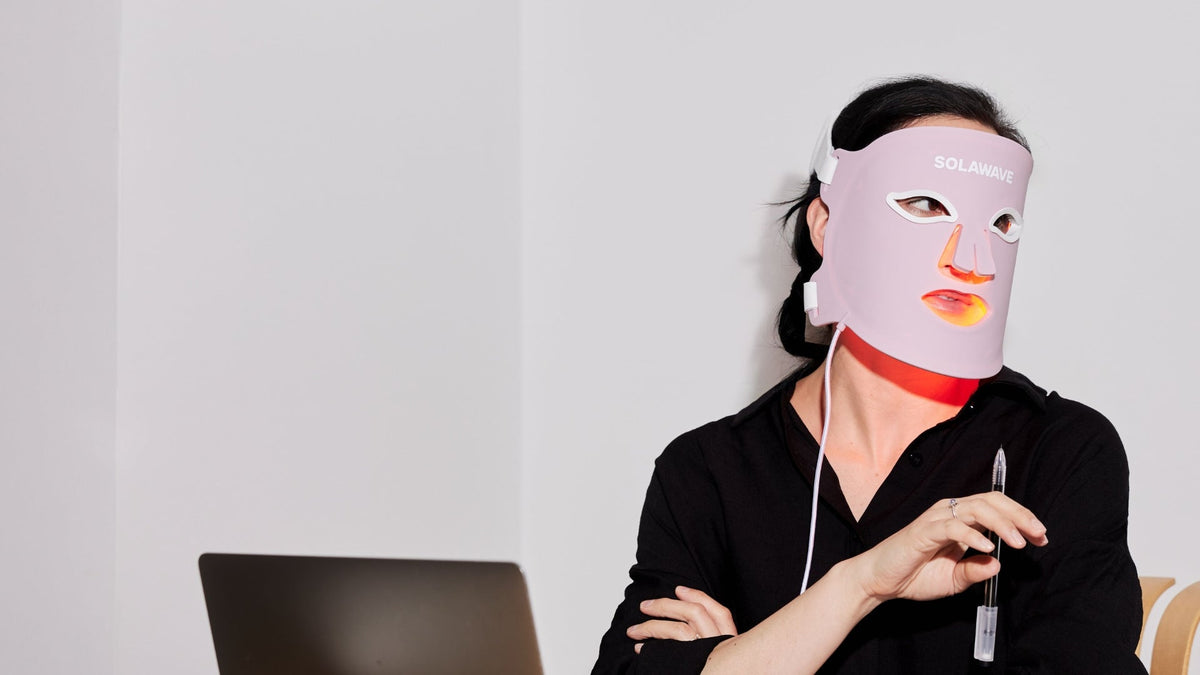
Here's what we can say with confidence. The wavelengths that researchers have studied for their anti-inflammatory and skin-calming properties are the same wavelengths delivered by professional-grade LED devices. The Wrinkle Retreat Pro LED Face Mask delivers four therapeutic wavelengths simultaneously. Red at 630nm, deep red at 660nm, amber at 605nm, and near-infrared at 830nm. That's 320 dual-core LEDs across every wavelength that the current body of research identifies as relevant for calming inflammation and supporting skin health.
The mask is FDA-cleared, non-UV, pain-free, and non-irritating. Each session takes just 3 minutes, 3 to 5 times per week. It uses soft, medical-grade silicone that sits gently against the skin, which is an important consideration for anyone whose skin reacts to pressure or friction.
That said, an important distinction. The Wrinkle Retreat Pro is designed and FDA-cleared for addressing the visible signs of skin aging, like fine lines, wrinkles, and uneven tone. Solawave does not claim that its devices treat rosacea. Rosacea is a medical condition, and managing it requires guidance from a board-certified dermatologist who can build a personalized treatment plan.
What we can say is that the gentle, non-invasive, anti-inflammatory properties of red and near-infrared light therapy make it a compelling option to discuss with your dermatologist as part of a broader skincare approach for rosacea-prone skin.
If you've searched for "red light therapy rosacea before and after," you've likely seen dramatic transformation photos across the internet. A word of caution here.
Individual results vary significantly based on rosacea subtype, severity, triggers, and overall treatment plan. The peer-reviewed case studies that exist are promising but small in scale, and researchers consistently call for larger, randomized controlled trials.
What the published evidence does consistently show is that LED therapy in the red and near-infrared range is well-tolerated, non-irritating, and does not carry the risks associated with lasers, IPL, or UV-based therapies, particularly for individuals with sensitive or reactive skin. Because red light targets mitochondria rather than melanin, it is also considered safe across all Fitzpatrick skin types.
If you're curious about how light therapy could fit into your routine, start with a conversation with your dermatologist. You can also explore more about how Solawave's technology works or browse the FAQs page for answers about device safety, usage, and compatibility with sensitive skin.
This article is for informational purposes only and is not intended as medical advice. Always consult a board-certified dermatologist for diagnosis and treatment of rosacea or any skin condition. Results may vary. Individual results are not guaranteed.
Peer-reviewed research shows that red light in the 630 to 660nm range has anti-inflammatory properties that may benefit rosacea-prone skin. However, rosacea is a medical condition, and any light therapy approach should be discussed with your dermatologist.
Red light therapy is non-UV, non-irritating, and does not target melanin, making it generally well-tolerated for sensitive and reactive skin types. It carries fewer risks than laser or IPL treatments, but always consult your dermatologist before starting.
LED masks that deliver red and near-infrared wavelengths offer the same light spectrum studied in rosacea research. While they are not marketed as rosacea treatments, their anti-inflammatory properties make them worth discussing with your dermatologist as part of a broader skincare plan.
Research points to red light in the 630 to 660nm range and near-infrared at 830nm as the most promising wavelengths for calming inflammation and supporting skin health in rosacea-prone skin. Amber light at 605nm may also help with visible redness.
Many LED face masks are gentle enough for sensitive skin, but it's essential to consult your dermatologist before adding any device to your routine. Look for FDA-cleared devices with non-UV wavelengths and medical-grade materials that sit gently against the skin.
Results vary depending on your rosacea subtype, severity, and overall treatment plan. Published case studies show promising reductions in redness and inflammation, but larger clinical trials are still needed. Consistency and professional guidance are both important.