Rated 4.7 out of 5 stars
4.7 / 5


726,000+ customers
Free 60-Day Returns
1-Year Warranty
726,000+ customers
Free 60-Day Returns
1-Year Warranty
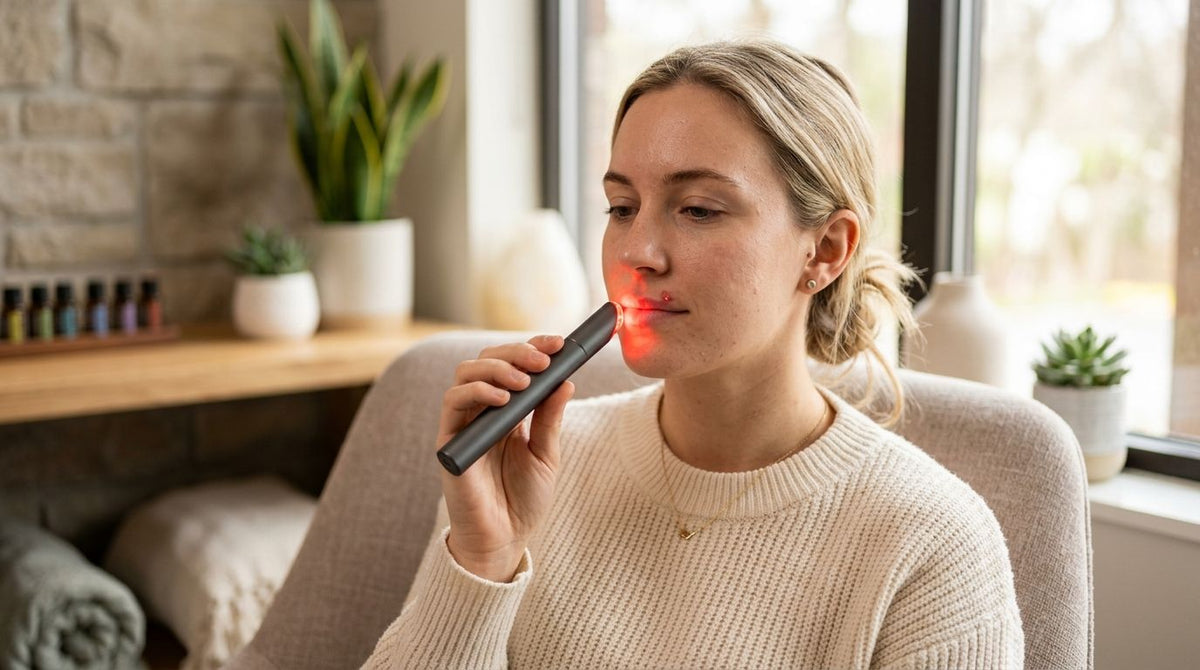
Red light therapy for cold sores is a skin-recovery habit for people who get frequent outbreaks, used to calm redness and support the skin barrier once a blister has already started healing — it is not a stand-alone cure and not a step you take while a lesion is still open. Anyone managing recurring herpes labialis (the medical name for cold sores) needs a routine built around antiviral timing first, skin support second, and hygiene running underneath both.
People who get cold sores aren't managing a one-time skin issue — they're managing a recurring condition that flares on its own schedule, often at the worst moments (before an event, during a stressful week, after too much sun). That changes what "skincare routine" means for this segment: it has to accommodate active outbreaks, healing skin, and clear skin, all in rotation.
Most general red light therapy content talks about wrinkles or acne timelines. Cold sore-prone skin needs different guidance: when a device is safe to use, when it isn't, and what actually shortens an outbreak versus what just feels productive. The single biggest mistake in this category is treating a red light wand as an antiviral tool — it isn't one, and using it on an open lesion risks spreading the virus to a device you'll use on the rest of your face later.
The window that matters most for a cold sore outbreak is the 24 hours before anything is visible.
This step happens before any light therapy, and it's the one with the most evidence behind it for actually shortening an outbreak.
This is where the timing matters most. Clinical research on low-level laser therapy for herpes labialis has looked at reduced healing time and lower recurrence rates when treatment is applied appropriately, but that research uses medical-grade devices and supervised protocols — not consumer skincare wands. Skip any red light device entirely while the blister is open, crusting, or weeping.
Once the skin has fully closed and there's no active lesion, a red light therapy wand becomes a reasonable option for calming leftover redness and supporting the skin barrier in that spot, the same way it would for any post-breakout mark.
Solawave's 4-in-1 Radiant Renewal Skincare Wand is FDA-cleared for wrinkles, fine lines, and other cosmetic skin concerns — a reasonable post-healing skin support tool, but not cleared, tested, or marketed as a cold sore treatment, and never something that should touch an open lesion.
Cold sores spread through direct contact, which makes device hygiene a bigger deal for this segment than for someone using red light therapy for wrinkles alone.
| Option | Best for | Key limitation |
|---|---|---|
| OTC antiviral cream (docosanol) | Mild, occasional cold sores caught at the tingling stage | Only effective if applied within the first 24 hours |
| Prescription antiviral (valacyclovir/acyclovir) | Frequent or severe outbreaks, 6+ per year | Requires a doctor visit and prescription |
| Cold sore healing patches | Discreetly covering an active blister | Doesn't meaningfully shorten healing once the blister has formed |
| At-home red light therapy wand | Calming redness on already-healed skin, general skin support | Not FDA-cleared as a cold sore treatment; unsafe on open lesions |


For anyone with reactive or easily irritated skin alongside recurring cold sores, the same caution around timing applies to red light therapy for sensitive skin — start conservative and watch for irritation before adding frequency.
Can red light therapy cure a cold sore?
No. Red light therapy does not cure cold sores or clear the herpes simplex virus. Antiviral cream or prescription medication started at the first tingle is what shortens an outbreak; red light therapy can only support skin recovery after the lesion has closed.
Is it safe to use a red light therapy wand on an active cold sore?
No. A red light device should never touch an open, crusting, or weeping cold sore. Wait until the area is fully closed with no discharge, and clean the device thoroughly before using it on the rest of your face.
Does Solawave's wand treat cold sores?
Solawave's 4-in-1 Radiant Renewal Skincare Wand is FDA-cleared for cosmetic concerns like wrinkles, fine lines, and dark spots — it is not FDA-cleared or marketed as a cold sore treatment. Use it on healed skin only.
What triggers cold sore outbreaks?
Sun exposure, stress, illness, hormonal shifts, and lip injury are the most commonly reported triggers. Tracking which of these precede your outbreaks helps you catch the tingling stage earlier next time.
How fast do OTC antiviral creams work on cold sores?
OTC antiviral creams like docosanol work best applied within the first 24 hours of tingling, before a visible blister forms. Applied after the blister appears, they do far less to shorten the outbreak.
How do you stop a cold sore from spreading to other people?
Avoid sharing lip balm, towels, razors, or drinks during an active outbreak, and avoid oral contact until the sore is fully healed. Wash your hands after touching the area.
Can stress cause cold sores?
Yes. Stress is one of the most commonly reported triggers for cold sore recurrence, alongside sun exposure and illness. Managing stress doesn't eliminate outbreaks but can reduce how often they happen for some people.
How is clinical laser therapy different from an at-home red light device?
Clinical studies on low-level laser therapy for herpes labialis use medical-grade equipment under supervision with set protocols. Consumer red light wands are cosmetic devices cleared for concerns like wrinkles and acne, not tested against that standard for active viral lesions.
Most U.S. adults carry HSV-1 antibodies, and many never develop a visible cold sore — which means the outbreak, not the virus, is the thing you're actually managing. In 2026 that distinction is still the most useful mental shift for anyone frustrated that their routine "isn't working": the routine was never going to remove the virus, only shorten and calm the outbreaks it causes. Build the antiviral response first, add red light therapy for the healed-skin phase, and keep hygiene running through the whole cycle — that order doesn't change in 2026 no matter which device sits in your bathroom.